| Itinerary |
|---|
.jpg)
| Day 1 - Vancouver to Victoria - 69 km/43 mi Please phone our station at 604-940-2171 after 08:00 this morning to arrange your transfer from the hotel to our station. Vehicle pickup times are generally between 13:00 and 16:00 but your exact time will be given to you when you phone. Detailed vehicle instruction will be provided. Do your grocery shopping and head out.full detailsThe Tsawwassen Ferry to Swartz Bay is the best choice for reaching Victoria quickly. The ferry ride is about two hours long. If the weather is fair, there is nothing better than to stand out on deck while navigating the narrow passages between the Gulf Islands. You enter a very narrow channel with a close view of Galiano Island on the north and Mayne Island on the south side, coming out on the south-west side of Salt Spring Island, winding your way toward Swartz Bay. As you approach the Bay, the island on the south side of the ferry is Pender Island.The islands offer a slower pace of life. There are small farms, acreages, and summer cottages. 20 minutes from the Swartz Bay Terminal is Beachcomber RV, our recommended campground for tonight. This campground offers CanaDream guests a discount during the off-season only. This is a good place to stay if you are planning to visit Butchart Gardens or the Victoria Butterfly Gardens in Brentwood Bay on the morning of Day 2. Other recommended attractions in the area are the Shaw Ocean Discovery Centre at the Port Sidney Marina and whale watching with Seaquest Adventures in Sidney. |

| Day 2 - Victoria Victoria has so many interesting activities to offer, you will have a full day fitting in just a few. Of course, Butchart Gardens, south of Swartz Bay, on Highway 17A, is world-reknowned and is a splendid, restful place to wander around and enjoy the day. You may find so much to do here that you decide to stay an extra day. Suggestions include whale watching with one of our CanaDream Club partners, a visit to Craigdarroch Castle, sailing or sea kayaking with Blackfish Adventures, a visit to the Royal BC Museum or a relaxing cycle trek with Cycle Treks Victoria. full detailsWhen in the centre of Victoria, there are a few venues worthy of particular mention. The Provincial Museum and the BC Legislative Building are next door to one another at the south end of Government Street. The Museum often hosts new and interesting exhibits and the Legislative Buildings are open to the public with regular tours. As well, there are tours of the Inner Harbour, which is just a few blocks west of Government Street. In the spring and summer, baskets of flowers hang from lampposts on all the downtown streets. If you are interested in collecting antiques, you may find just the right item in an antique shop along Fort Street. If you follow Bay Street to just west of the Inner Harbour, the street name changes to Craigflower Road. On the west side of Admirals Road, you will come to a heritage farmstead named Craigflower. This farm was established back in 1853 because of an obligation to Britain that the Hudson’s Bay Company honoured in order to encourage colonization. The farm also experimented with certain seeds and tubors in order to learn what would grow best on the island.
If you enjoy viewing shipping traffic, you can drive or cycle around the ocean front by going south from Government House down to Beacon Hill Road and following it around to the Oak Bay Marina. When you are looking directly south of this coastline, there is a great view of the Olympic Mountains in Washington State . As well, there is a great view from China Beach west of Victoria past Sooke. In addition to the great viewpoint at China Beach, there is a very scenic beach walk about ½ km down the hill from the parking lot. Adults and kids can enjoy beach-combing for sea shells or just laying on the wide expanse of sand to relax. If you are inclined to "stretch your legs", you can walk for kilometres along the beach to discover rocky tidal pools and explore ocean-side trails.
There is a tea house at Point No Point that is built on the edge of the cliff, providing a great view of the entrance to the Juan de Fuca Strait from the Pacific Ocean. You can have afternoon tea here while you watch everything from small craft to the larger cargo ships enter the Strait on their way to the Vancouver and Seattle harbours. Along this road, you will see the Race Rocks Light Station on the promontory known as Robert’s Point. This lighthouse was built back in the late 1800s to warn ships of the destructive outcropping of rocks that jutted out at the point where they entered the Juan de Fuca Strait. This was the location of many tragic shipwrecks over the years, even after the lighthouse was built. In later years, they changed the direction of the foghorn’s blasts and met with better results. Now the light station is a nature reserve and is part of the University of Victoria Biology Department’s course delivery. A lighthouse that is open for viewing is the Fisguard Lighthouse National Historic Site, together with the Fort Rodd Hill that was built to protect Victoria and her harbour as well as the naval base at Esquimalt.
There are three CanaDream Club campground partners close to downtown Victoria and we recommend you stay with one of these partners tonight so you are closer to the downtown attractions. These partners are listed on the left of this page and you can click through to their websites for their locations and further information. All campground partners provide CanaDream guests with a discount (some blackout dates may apply). |

| Day 3 - Victoria to Tofino - 316 km/199 mi Expect the unexpected on your drive to Tofino. There is such a variety of scenery with every bend in the road, from thick forest, to small towns, and spectacular views of the Gulf Islands that are sprinkled throughout the Strait of Georgia. It is advisable to leave a little early and give yourself ample time on this leg of the journey, as the Port Alberni to Tofino leg is a very narrow, winding road and will likely be quite a slow portion of the day’s drive. full detailsOn your way up the Trans Canada Highway, Goldstream and Bamberton Provincial Parks are both worthwhile stops for a scenic break. Duncan, nestled in the Cowichan Valley, is also an interesting stop. The Lumber Mill Museum is worth a look. Duncan is known as the “City of Totems”. In the downtown area, you will find a historic totem pole walking tour. This island town also gives you access to mountain biking and hiking trails, and scuba diving, canoeing, kayaking and fishing. Oh, what to do? Taking into account the five hour drive to Tofino, you may still find time to squeeze in an extra activity or two along the way. Part way up the west side of the island, you will come to a town named Chemainus. This is a pretty little seaside town with different murals painted on the sides of five downtown buildings. These murals depict the town’s corporate history and community spirit.
Branching off the Trans Canada Highway onto Highway 4, just north of Nanaimo, you will be on your way to Port Alberni and Tofino. Stop for lunch at Coombs to see the goats that graze on the roof of a local cafe/bakery. Before reaching Port Alberni the highway passes through MacMillan Provincial Park where you'll can walk among huge old-growth rain forest at Cathedral Grove with trees up to two to three metres thick. There are only a few dozen parking spots immediately adjacent to the highway at the entrance to the trail to Cathedral Grove. Please proceed slowly through this stretch of road, as the trees encroach on the road and there may be little warning when people, as well as wildlife, cross the road.
You are getting into mountainous and forested terrain at this point and there is more wildlife viewing potential. Begin looking for cougar tracks here. It is not recommended to walk too far on your own; traveling in larger groups is advisable. Vancouver Island has a high concentration of cougar populations, although confrontations are very rare. Tofino is on the northern edge of Pacific Rim National Park, and is the northern end of the well-known West Coast Trail. This is a backpacking trail that usually takes five or six days to complete and requires climbing up and down ladders that hang from cliffs, walking over large fallen logs and crossing expansive rock flats and beaches while the tide is out. It is an isolated but very popular hike, thereby requiring reservations to embark on the route. From Port Alberni to Tofino, the highway narrows. Traffic usually slows down somewhat through this section to accommodate the winding, mountainous terrain. For this reason, it is wise to build five hours into your schedule to make your drive less pressured.
|

| Day 4 - Full day in Tofino What an incredible playground! From all the possible activities, here are a few suggestions to tantalize and inspire you. Whale watching tours are one possibility that are available from Spring to Fall.. full detailsThe charter companies take you out in larger power boats, cutting the motor when they are close and never getting too close to infringe on whale movements. These charters also take passengers out in summer to watch for bears that forage along the beaches when the tide is out. There are a few sea-kayaking companies that offer lessons and day trips, as well as longer tours. There have been many people who have seen a whale spout very close to their kayak.
If sport fishing is more to your liking, Weigh West Marine Resort will take you out to the salmon and halibut grounds for a few hours or a full day. Minimum numbers may apply. Surfing enthusiasts may wish to take surf lessons with local instructors while others may prefer exploring the underwater world with affordable snorkelling and scuba diving rentals. These are just a few of the aquatic possibilities. If you are passionate about playing golf, then there is a golf course overlooking the ocean. The third hole may catch you out, as the fairway looks completely straight, but it actually has a very gentle curve. It seems that if you missed, your ball will be in the Pacific. For this reason, it is one of the most challenging fairways on the island. With all these activities to choose from, it seems that you could have a busy day here. Maybe you could consider extending your time in Tofino to fit everything in. |

| Day 5 - Tofino to Whistler - 304 km/188 mi A return trip down the winding road to Port Alberni is the only way back to the east and more populated side of the island. You have a fairly long drive ahead of you so we suggest you start out fairly early as you may have to wait for an available ferry crossing if you don't have reservations.full detailsIt is recommended that you board the ferry at Departure Bay (Nanaimo). It takes a little less time than the Swartz Bay ferry, but it arrives at a terminal called Horseshoe Bay, north of Vancouver, making the drive through urban areas largely unnecessary. Highway 99 north to Whistler is easily accessible as you exit the ferry terminal. The ferry leaves Departure Bay approx every two hours between 06:30 and 21:00. You may wish to break today's journey into a two day trip, perhaps spending the night in Nanaimo before catching the ferry across to Horseshoe Bay the following day.
If you plan to do this trip in one day, allow a minimum of nine hours, taking into consideration the five hours to drive between Tofino and Nanaimo, two hours for the ferry crossing and a minimum of one and half to two hours for the drive to Whistler (without the suggested stops below).
The drive to Whistler is scenic, and the Squamish Highway (The Sea to Sky Highway) is notorious for its scenic mountainous roads. Hugging the coast all the way to the top of Howe Sound, then heading inland, the Sea to Sky Highway has a number of scenic viewpoints where you can stop and safely enjoy the views. Pass through Lions Bay and Porteau Cove before reaching Britannia Beach. Britannia Beach is most famous as a mining community and was built up around the copper mine. The mine ceased production in 1974 but just a year later it was opened as the Britannia Mine Museum and is now a national historic site. Mine tours take place daily and discounted admission is available to CanaDream guests when vouchered through CanaDream. Stop at Shannon Falls Provincial Park to view the magnificent falls. Shannon Falls are the third highest in BC at 335 metres above the Sea to Sky Highway. If you don't feel like driving any further today or want to spend more time exploring sights along the Sea to Sky Highway, we suggest you break your trip in Squamish. There are two CanaDream Club partner campgrounds in Squamish who would be delighted to welcome you. Eagle Vista RV Resort is situated in a park-like setting close to town while Paradise Valley Campground's location just off Highway 99 along the beautiful Cheakamus River offers a wilderness camping experience in its simplest form. If you decide to overnight in Squamish and the weather is good, how about taking a scenic flight over the Whistler and Blackcomb Mountains with Glacier Air or a whitewater trip down the Cheakamus River with Sunwolf Rafting.
Our CanaDream Club partner campground in the Whistler area is Whistler RV Park, 18km south of Whistler township. This campground is open year round and offers CanaDream guests a 10% discount on request. Just 11km (7 miles) south of Whistler is Brandywine Falls Provincial Park. Here a spectacular 70 metre waterfall is best seen from the viewpoint which also presents some marvellous views of Daisy Lake and the surrounding mountains. |

| Day 6 - Full day in Whistler Whistler has lots to offer the summer visitor. Besides a scenic lake to hike around, a gondola that offers memorable views and a fantastic mountain bike park, there are four championship golf courses to choose from. These courses were designed by golfing’s greats—Robert Cupp, Robert Trent Jones Jr., Arnold Palmer, and Jack Nicklaus. So if you are into golf, these courses will definitely be a memorable challenge. full detailsIf golf does not interest you, allow yourself to experience adventure in the wilds. Go horseback riding in the mountains, or race down steep, jagged trails on a mountain bike. How about taking a canoe trip down the River of Golden Dreams with Backroads Whistler, riding an ATV to the Crystal Hut perched atop Blackcomb Mountain and enjoying a salmon bake there or going white water rafting through pulsing rapids on the Upper Lillooet River? For a more sedentary and cultural experience, visit the Squamish Lil'wat Cultural Centre to learn about two distinctly different BC First Nations. For a truly spectacular view of the mountains, join Blackcomb Aviation on one of their helicopter sightseeing flights. Even in summer, skiing and snowboarding are possibilities. They allow winter sports on Blackcomb Glacier during the summer. The choices are many - Whistler has all of these possibilities. The opportunity for outdoor activities and recreation won’t disappoint you.
|

| Day 7 - Whistler to Sun Peaks - 360 km/224 mi Highway 99 from Whistler to Sun Peaks is not as busy as some in British Columbia, making the drive a leisurely one. You will be driving in somewhat isolated areas, with lots of lakes, rivers, forest, and wildlife, but not too many towns or gas stations. Be sure that your gas tank is full before leaving the town of Mount Currie. full detailsIf you turn right at Pemberton and continue on Highway 99 to the Trans Canada Highway (No. 1), you will be a short drive north of Cache Creek. When you come to Cache Creek, turn right and drive along Highway 97, which will bring you to Kamloops. Sun Peaks is just northeast of Kamloops. While driving between Cache Creek and Kamloops in mid-July, be on the lookout for a large number of cattle, wranglers, and some inexperienced riders on horseback. This is the annual cattle drive from Cache Creek to Kamloops. Cache Creek is nestled amid desert and grassland plateaus, steep river valleys and steep mountains. The town was the halfway point for travelers on their way to the gold nuggets awaiting them in the Cariboo Mountains to the northwest. It is part of the Cariboo Gold Rush Trail that visitors can still follow today. Some people say the town got its name because gold rush travelers used to camp there for the night, needing a place to rest and hide their “cache”. Others prefer the tale about a couple of bandits who held up a freight delivery service bringing gold from the Cariboo region down to Ashcroft to load on the train. The BC Provincial Police tracked these bandits and killed one of them in a brief skirmish. The other bandit was wounded, and was forced to bury the gold near a creek, before fleeing back to the States. He died there before returning for the gold. To date, no one has found the buried treasure.
When you arrive in Sun Peaks, you will find another challenging golf course to conquer. The spot reserved for RVs (Bentos Parking Lot (P2)) is just across the road from the entrance to the golf course. There are no hook-ups in this lot, but parking here is free of charge.Just about every day of the summer, there is a special activity scheduled.
|

| Day 8 - Sun Peaks to Jasper - 455 km/283 mi On this leg of the journey, be prepared to see some wildlife beside the highway. The elevation gain seems moderate, but the scenery is varied and majestic. This is another route with few gas stations. There are not that many services to count on between Clearwater and Blue River and then little available until Valemount. full detailsYou will need to be aware of your gas gauge and fill up even if you have recently done so. Watch for black bears, moose and elk along this stretch of the route.
Drop in at the very helpful Visitor Centre in Clearwater to get information on this region. You may like to extend your trip at this point by spending a day or two in the area. Wells Gray Park is worth a visit. Some of the main attractions within a short walk from the parking lots along the main access road in the park are:
- Helmcken Falls - this takes most people by surprise, as you think you're on level ground when you come across a waterfall twice the height of Niagara Falls.
- Trophy Mountain Buffalo Ranch - Located just outside the park, to the south, this ranch offers camping and trail rides and operates a restaurant where you can enjoy professionally prepared tender steak from buffalo that are free to roam within large enclosures and eat wild grasses, straw and hay. In the summer months you can dine outdoors here. CanaDream guests can download a coupon from our website giving them a discount on camping and trail riding here.
As you travel north on Highway 5 towards Blue River, look out for signs along the road to River Safari. This is an awe-inspiring one hour boat ride through Grizzly Bear Valley in the Monashee Mountains and an experience not to be missed. Bear, moose, eagles and osprey are only a few of the magnificent creatures you may see during this wilderness experience. Reservations are not necessary as safaris depart every 30 minutes. Discounted tickets are available through CanaDream.
From Blue River, continue north on Highway 5 towards Tête Jaune Cache. There was a fur trader living and trapping in the area in the early 1800s. The natives and other fur traders named him Tête Jaune because of his golden blonde hair. He kept his cache of pelts at this spot in preparation for the trading season. When you turn the corner at Tête Jaune Cache, you will be able to see Mount Robson, the highest peak in the Rockies, the second highest in Canada . Mount Robson Provincial Park is a great place to take a break and stretch your legs. You can easily walk down along the river bordering the parking lot. For the more adventurous, there are hiking trails available with more information on routes and markers available at the Provincial Park parking lot.
|

| Day 9 - Full day in Jasper There are many campgrounds very close in to Jasper that are well suited to RVs. Many offer nature daily presentations in the campground ampitheatre throughout the summer season. It is wise to phone a day or two ahead and book a spot, as these campgrounds are very popular and fill up fast. The campgrounds are not as full on weekdays, but it is a good idea to reserve just the same.full detailsJasper is the most northerly of towns located in the National Parks straddling the Rocky Mountains. It is less commercialized than Banff, but still offers a wonderful visit, especially for the outdoor enthusiast. Guides and outfitters, are available to lead trips to the best fishing spots and horseback riding trails (around Pyramid Lake ).
There are places to rent canoes and lots of venues perfect for a day hike. Sunwapta Falls are thrilling to see as the power of the water cascading down the rocky cliffs is deafening as well as humbling. As well, Maligne Canyon is a spectacular sight, This is a very deep canyon with all sorts of twists and turns down among the rocks. The rocks have been worn smooth by the force of the water rushing through its narrow channels. When the light reflects off of the shiny rocks, it creates a challenge for a keen photographer. There is a bit of a climb up to the viewing areas, but you will find it well worthwhile. For fishing and boat touring, a visit to Maligne Lake and Spirit Island is an enjoyable day out.
Since the Marmot Basin gondola can say it has the longest ride in the Rockies with a vertical climb of 2,300 m (7,500 ft.), it offers a terrific view of the Jasper region. From the top of Whistler Mountain you can see six mountain ranges. Mount Edith Cavell is a very majestic mountain, named after a British nurse who served in a Red Cross Hospital in Brussels during World War I. She was executed in October of 1915 because she cared for wounded soldiers, then assisted them to escape from behind enemy lines, rejoin their armies and return home. The highest of three summits is surveyed at 11,034 feet and was first climbed in 1915. It is a popular mountain for climbers—all climbs are considered quite easy. |

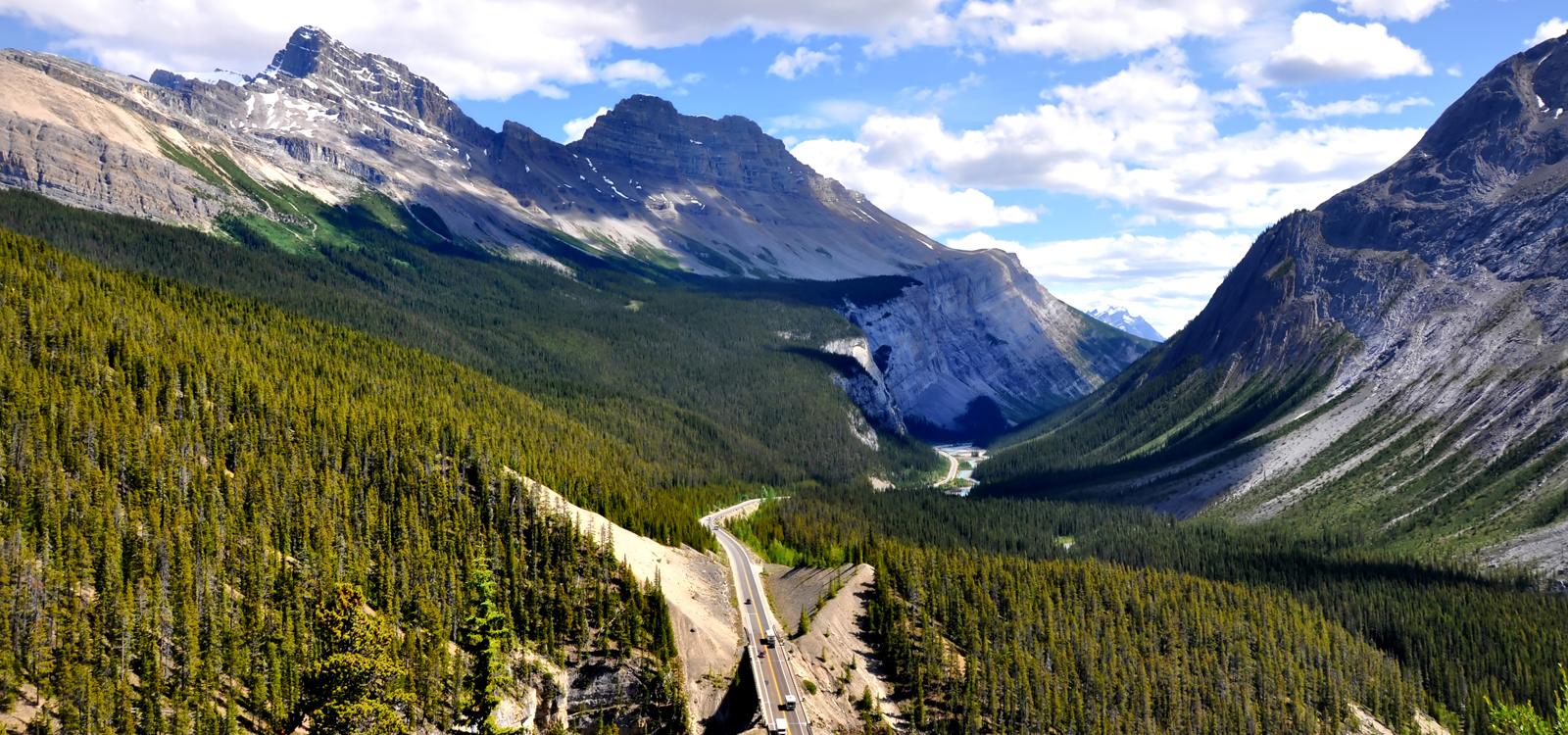
| Day 10 - Jasper to Banff - 293 km/182 mi The Icefields Parkway between Jasper and Banff offers scenery and surprises. As you drive along Highway 93, you will experience sudden climbs, wide turns with expansive views followed suddenly by steep descents into forested valleys, along side thundering waterfalls that cascade down to riverbeds several kilometers wide. full detailsThe scenery can be a little eye-popping, so it is a good thing there are a few viewpoints where you can pull over and get out to get a better look.
Interesting stops include Athabasca Falls, Sunwapta Falls, and the Kerkeslin Goat Lick. The Lick is a layer of white mineral deposits that lie beside the road and at the viewpoint. Mount Kerkeslin is notable for its red cliffs off in the distance. Mountain goats favour the mineral deposits and frequently come down to the roadside for a treat. There is often wildlife to be seen straddling Highway 93. On this stretch, you may be lucky and see a grizzly bear or a herd of mountain caribou (which are an endangered species in Alberta ). Also, elk, bighorn sheep and mountain goats are very common sights. Black bears are often seen at the Valley of the Five Lakes trailhead that comes down to the roadway. Watch for sudden movements when the animals may decide to cross in front of traffic. As you drive along this section of the Parkway, you will pass Tangle Falls and on the other side of the vehicle, you will be driving just at the edge of Tangle Ridge. Mountain goats and sheep like this ridge and seem to have no concern about clambering around on the rocky cliffs.
If you are ready to stretch your legs and get out in the mountain air, there is an easy stroll known as East Bush Falls Loop near the Nordegg turnoff. It offers the bonus of a waterfall on East Bush Creek. The hikes in this area are mostly old logging roads, making good hiking and equestrian trails today. Apparently, there are people who get lost on East Bush Mountain , so it is important to follow the signs posted. The route is not quite 6 km long and has a slight elevation gain of 90 metres, requiring as much as a half-day to complete. Perhaps the explorer David Thompson passed this way around 1800 when he traversed mountain passes in the Rockies in his search for an easy route to the Pacific Ocean. If you are extra adventurous, you may prefer a loftier view of the Columbia Icefields. It is possible to see the Icefields from a helicopter instead. Icefield Helicopter Tours will fly you over the glacier in as little time as 15 minutes or take you on a trip that can last as long as one hour. You can get to the landing pad by turning off of Highway 93 and go east on Highway 11, where the sign points to Rocky Mountain House. On your descent from the Icefields, you will have a chance to see Mount Athabasca, Columbia Glacier and the Columbia Icefields. Or, if you prefer a close up view, you can get right on the glaciers and walk around. On the east side of the highway near the ramp for Highway 11, you will see the parking area for the Snowcoaches that take you onto the Columbia Glacier (between May and September). As you come around the bend in the road near Bow Summit, the highest point on the Parkway, you will see a spectacular vista spread out before you. Then, as you round the turn, you begin a slow descent to the valley below. Once you reach the valley bottom, watch for moose and black bears. Peyto Lake (pronounced Peeto) is another worthy stop along the way. This lake is south of the Columbia Icefields and close to the Bow Glacier lookout. The walk from the parking lot to the viewpoint takes about ten minutes; but, when you see the Lake, it should be well worth the time it takes to pull off the road and divert your itinerary. The glacial silt lying below the water reflects light to give the lake this unusual colour. As the light lessens, the colour of the water changes to a darker, truer green and blue. At the junction of Highway 93 and the Trans Canada Highway, turn toward Lake Louise, heading east. Depending on the lateness in the day, you may want to stop in Lake Louise on your way to Banff.
|

| Day 11 - Full day in Banff You may not have thought of finding so much art in a place like Banff. This town offers you a multitude of artistic activities. The Banff Summer Arts Festival has many artists performing in a variety of ways from June to August. Try a world class opera production, different musical ensembles or theatre, an art walk, exhibitions or literary reading. Whatever your taste, there is something for everyone throughout the Festival. full detailsThe Whyte Museum of the Rockies holds a very large collection of mountain art by a wide variety of artists who either lived in the Park or spent time working in the area. As for physical activity, Banff offers a great deal to keep you occupied. You can hike east along the Bow River valley to the hoodoos (eroded rock formations by the river’s edge), hike up Sulphur Mountain and take the gondola down for free, then take a soothing dip in the Banff Hot Springs at the base of Sulphur Mountain. Or you could go to the west side of town and rent a canoe and paddle northwest along the creek to the Vermillion Lakes . You may have to portage around a beaver dam or two, may even spot some beavers at work maintaining their homes, but the view of Mount Rundle (the jagged, sloping mountain you see from Vermillion Lakes when you look straight west) is wonderful, especially when you see it early on a clear morning or later in the evening. For the first few hours of the morning, you would see the sun rise over the mountain, turning its warm, sandy brown tones to a soft pink. The same is true at dusk. Sunset comes very quickly in the mountains, so once the mountain turns pink, it is time to head back to the dock. An interesting area for exploring is the old, abandoned townsite of Bankhead, just north of the Trans Canada Highway turnoff. Look for an unmarked parking lot on the right just after the Two Jack Lake Camping Ground access. This was a model town built and developed by the Canadian Pacific Railway about 100 years ago to support a coal-mining endeavor that the Railway owned. Bankhead was the envy of all the towns in the area, because the residents enjoyed indoor plumbing and electric lighting in their homes and on the streets. They built up sports teams and the residents themselves provided the entertainment in local musical performances. The town lasted the 20 years that the mine was profitable. Then, when the use of coal declined, the CPR closed the mine and moved the town buildings to Banff , Canmore and Calgary . There are still some building foundations left and some interesting displays. The town is north of Banff on the road leading to Lake Minnewanka . There is a town beneath the water that used to support an earlier coal mine. The town’s name was Anthracite, an indication of the type of coal they hoped to find. However, the mine was a failure and the residents had packed up and moved out by 1904. Sometime after the residents moved away, Calgary Power, now TransAlta Utilities, flooded the area to produce hydro-electric power. There had been a lake there before, although not as wide.
|

| Day 12 - Banff to Revelstoke - 287 km/179 mi A stop in Lake Louise allows you to view the six glaciers that come from the valley at the south end of the lake. Mount Victoria and its Glacier are directly in front of you when you are standing at the north end of the lake. There is a short hike around the west side of the Lake. There are often rock climbing students doing practice climbs on the cliffs at the southern corner of the Lake, where the pathway melds with a horse trail. full detailsThere is also a brief climb up to the Lake Agnes Tea House, not far from Chateau Lake Louise's front lawn. In the summer, alphorn players and pipers perform on the front lawn. You can rent canoes at the boathouse and paddle around the Lake, which is usually quite calm.
Along the way to Revelstoke, you pass through two National Parks – Glacier and Yoho. Yoho Park is the location of the world-renowned Burgess Shale, a UNESCO World Heritage site. The Burgess Shale is an expansive area of pre-Cambrian fossils. Of special interest in this bed are very small snails and other sea life that inhabited the area in a shallow sea millions of years ago. The Shale is accessible from the town of Field . You can hike up to the fossil beds in a six-hour return trip to Mount Stephen, but only with a guide in a small group. It is necessary to book ahead to be able to see this prehistoric wonder.
While in Yoho, you will traverse the Kicking Horse Pass. Yoho National Park also has picturesque lakes and a waterfall that make for a great stop. Takakkaw Falls is just off the Trans Canada Highway and has a vertical drop of 373 metres, giving it the honour of being one of the highest waterfalls in Canada . There is a bridge to walk across so that you have an excellent view almost beneath the falls themselves. To get there, follow the Yoho Valley Road that turns north three kilometres west of Field and continue for 13 kilometres. The road to these falls is a Summer road only. It generally opens in late June and is closed by the end of September. Another worthwhile spot is Emerald Lake —showing off a truly vibrant dark green. There are free interpretive hikes around the lake that don’t take too long (5 kilometres). They are led by Parks Canada staff who are knowledgeable on geology, geography and natural history of the area. Vehicles are not allowed on the lake property. There is a parking lot located close by the Lake and a shuttle bus is available to drive you up to the Lake if needed. Then, at Golden, the valley for the Kicking Horse River is visible and accessible. The winding road before Golden will keep you on your toes with cliffs below and above. This river offers a white-water rafting adventure with some of the rapids rated at 6.
Once you arrive in Revelstoke for the evening, there are great golf courses to try out. The Revelstoke Golf Club is a very challenging, championship course built in 1924. The view from the course and the clubhouse looks out over the Revelstoke and Columbia Rivers. If golf is your game, call ahead for a suitable tee time at 1-250-837-2440, or go canoeing on the Columbia River, around the Upper Arrow Lake or even Lake Revelstoke itself. These lakes offer breathtaking scenery and an evening of quiet solitude. There are also three hot springs in the area—Canyon Hot Springs located right on the Trans Canada Highway, and the Halcyon and Nakusp Hot Springs that can be reached by driving a few kilometres south of the Canyon Hot Springs on Highway 23. In the Revelstoke area itself, you can drive up to a parking lot at Balsam Lake, high on Mount Revelstoke and hike for a short distance to the summit area. There are terrific opportunities for photography up here. This mountain area has an historic fire tower that you can visit on your hike around the summit. Revelstoke has about 60 historic edifices and at least two dozen of these buildings are in easy walking distance of each other in the downtown district. Maps of suggested walking tours are available from the visitor centres.
|

| Day 13 - Revelstoke to Peachland - 229 km/142 mi From Revelstoke, the drive takes you past Craigellachie. The CPR had built the railway from the east coast as far as Calgary, and meanwhile, they were laying track from the Pacific Ocean up through the Fraser Canyon. In the interim, they had to find a route to lay track through the mountain passes of the Rocky Mountain and Selkirk Ranges. full detailsWhen the route had been devised and the track laid from the east with a great deal of danger and toil, the two railway construction crews met at Craigellachie. It is here the last spike was driven into the ties on the Canadian Pacific Railway line creating rail service from the east coast all the way to the west.
2km before Craigellachie is Crazy Creek Resort, a new RV Park adjacent to hot pools, with boardwalks and nature trails to Crazy Creek Waterfalls and the 240' Suspension Bridge over the canyon. Crazy Creek Resort offers CanaDream guests a discount off overnight camping fees with no blackout dates. Not far beyond Craigellachie, try touring a ghost town at 3-Valley Gap. Brochures with a discount coupon for this attraction are available from our Vancouver and Calgary locations.
Along this stretch of the Trans Canada, the deep blue of the Shuswap Lake suddenly appears through the trees. Along the shores of this deep and vast lake, sandy beaches have a certain allure. There is excellent fishing here, as well. There are large tracts of forested land verging on the shore with high vantage points along the route.
The Shuswap has four arms that meet just north of Sicamous. During the summer months, you will drive along beside the Lake and see large numbers of houseboats along the shoreline. This is a very popular summer holiday destination and houseboats seem to be the craft of choice on the Lake. The climate here is perfect for growing all manner of vegetables. Take the turnoff for Highway 97A to Kelowna by way of Mara Lake. The O’Keefe Ranch is an historic landmark that is well worth seeing when passing through Vernon. It gives a glimpse into the Victorian way of life experienced in the late 1800s in this part of Canada. There are several buildings on the Ranch that are open for viewing. O'Keefe Ranch also has an RV Park with unserviced campsites for self-contained vehicles adjacent to their heritage site. A discount is available on request for CanaDream guests at the RV Park with no blackout dates. As you go further south from Vernon, there are expansive fruit orchards and wineries along the route to Peachland. All during the summer, there are many varieties of fruit for sale from open-air stalls along the highways. The cherries, peaches and pears have that fresh-picked flavour. CanaDream Partners on today's itinerary: Crazy Creek Resort Campground 3-Valley Gap Ghost Town O'Keefe Ranch RV Park
|

| Day 14 - Full day in Peachland Peachland is a haven for sun-lovers who require access to extensive beaches along the Okanagan Lake. It is nestled between two mountains-- Mount Drought and Mount Coldham and Okanagan Lake, creating steep property lines for residents. Perhaps, while settled in your spot on one of the pebble beaches, you will be fortunate and have a rare glimpse of Ogopogo, the Okanagan Lake’s very own Loch Ness monster. full detailsAccording to a First Nations legend, Ogopogo lives in an underwater cave located between Rattlesnake Island and Squally Point across the Lake from Peachland.
Peachland attracted settlers to the region in the mid to late 1800s. At first, they came for the fur trade, and later, for the gold rush. In 1898, Mr. J.M. Robinson came with those looking for gold. He settled here and operated a gold mine up in the hills above present-day Peachland. Most settlers enjoyed the warm climate, especially in winter. Peaches were a principal crop grown on the hills above the town. The produce was abundant creating the need for packing plants. A few packing plants were built along the shore of the lake, making it possible to ship the fruit to destinations beyond the Okanagan. Steamboats and sternwheelers traversed the Okanagan Lake system, providing fresh and canned fruit for other regions. The Kettle Valley Steam Railway takes you on a ride through the past. Enjoy a slower, genteel pace as you chug past fruit orchards and wineries and enjoy some on-board entertainment. You can catch the train at either the Canyon Creek Siding at the Trout Creek Bridge or the Prairie Valley Station in Summerland, a town just south of Peachland. The rides generally take half a day to complete. It is also possible to arrange one-way trips if you would like to take a bicycle on board and cycle back to where you left your RV.
The Kettle Valley Railway shut down rail service to Hope in the mid-1980s, and about ten years later, the railway line was converted into a section of the Trans Canada Trail. This pathway offers routes from Summerland up and down the Okanagan valley as far south as Osoyoos. Some of the trestles in the Myra Canyon section of the Trail were destroyed in the forest fires that ravaged the Okanagan area in the summer of 2003. These trestles have now been rebuilt to historical specifications using British Columbia wood and labour and the 12km route between Myra and Ruth trailheads reopened on June 22 2008. . For an additional challenge, try collecting Trail passport stamps attainable at various businesses along the Trail.
|

| Day 15 - Peachland to Hope - 285 km/177 mi Leaving Peachland en-route to Hope, you come across a few options for special interest stops. Drive south from Peachland on Highway 3A, where you will come to the historic town of Keremeos. It is mostly known for its orchards, fruit stands and ranching.
full detailsThe Keremeos Columns make for an interesting stop along the highway. They are basalt columns that have eroded over 30 million years. They are located in a provincial park off the 3A Highway, just four kilometres north of the junction for Highway 3. This is an interesting spot to wander around.
Turn west on Highway 3 at this point and carry on to Princeton. Here you will find a very unique museum that displays treasures and trinkets from the history of the area. The Museum delves into the town’s mining history. As well, it offers a butterfly collection, a display of local mineral finds and dinosaur bones, in addition to First Nations art and historic displays of clothing and artifacts. There are other more versatile exhibitions in addition to the stable displays. Continuing on Highway 3, you will follow a gradual descent down through Manning Provincial Park. This Park is in a great location for an afternoon refreshment break. While in the Park, you are parked in the shadow of the Cascade Mountains, just a few kilometres north of the border with the United States. Because of the unique climate of this area, the Park is rich in bird life. If birding is a particular hobby, you will want to bring your binoculars. Making time for a few breaks along the way, this route brings you to Hope by late afternoon. If you feel like some activity to wind down your day, you are in the vicinity of some great paddling destinations. Kawkawa Lake, Lake of the Woods, and Silver Lake all make for an evening of adventure and solitude. If kayaking is more along your line, the Fraser and Coquihalla Rivers both offer excellent beginner level workouts. Or if you enjoy an evening stroll, a self-guided forestry trail is accessible from the Hunter Creek Rest Area. There are also self-guided walking tours—such as the “Chain-Saw” walking tour or the “First Blood” walking tour, a route that takes you past all the filming spots of the first major movie to be filmed in the town of Hope . Maps are available at the town’s visitor centres. All in all, there is no shortage of interesting sights and enjoyable activities to add to a memorable holiday.
|

| Day 16 - Hope to Vancouver Station - 180 km/112 mi You are now just a few hours from the outskirts of Vancouver. If you feel like the extra drive, you could drive about an hour north of Hope and take a ride on the Hell’s Gate Skytram, a gondola ride that takes you across a canyon at the most narrow and turbulent portion of the Fraser River’s descent to the Pacific Ocean . Back on the Trans Canada Highway, you will pass by Hope once more and continue on toward Vancouver. full detailsFrom the Highway, there is a turn-off that takes you into a viewing area of the Bridal Veil Falls—a very high and narrow ribbon of water that falls in a turbulent mist, giving the observer the impression of a bridal veil. Well, perhaps you have had enough of dramatically cascading, pulsing water! Fort Langley, on the south side of the Fraser River, was an early Hudson’s Bay Company settlement, declining after 1864. After this, navigation of the Fraser was extended as far as Fort Hope and Fort Yale, leaving Fort Langley unable to cope with the competition. Today it is a Provincial Historic Site. As you drive along the Fraser River delta, you have a choice to cross to the north of the River on your return to Vancouver. This route takes you through smaller towns and verdant country-side instead of the Trans Canada which gets very busy at this point. If you cross the Fraser River to the north side, the town of Maple Ridge is a pleasant diversion directly north of Fort Langley. There is also a town named Steveston on the Fraser delta, at the mouth of the Fraser River in the southwest corner of Richmond. It is a former fishing village and in the late 1800s and first half of the last century, it was largely populated by Japanese immigrants who worked as fishermen, cannery workers and berry farmers. After Pearl Harbour, the residents were evicted from the area and confined to internment camps for the remainder of the Second World War. The residents were not allowed to return to the town and resume their fishing activities. Steveston is now in the process of being restored. There are plans to restore many more buildings, but at the moment, the cannery and harbour offer an interesting side trip off the freeway. Steveston Seabreeze Adventures offer whale watching tours, sea lion and bird watching tours and bike rentals. Discounts are available by booking direct with CanaDream. From the Fraser Delta and these outlying towns, you have just a short drive ahead of you, bringing you to the end of your adventure at our CanaDream Vancouver Station. Unless you have a late dropoff included in your booking, you need to arrive at our station between 08:00 and 10:00. Our friendly station staff will be happy to take you to the airport or an airport hotel after drop-off.
|