Page 14 - CanaDream 2025 TCA English
P. 14
DRIVING & MANEUVERING THE RV
TIPS FOR A SAFE TRIP CLEARANCES
The RV has many of the same driver controls and cab features as the RVs are much taller than conventional vehicles. At least 4 meters
automobiles you have driven. Although the RV is taller, longer and (13 feet) of clearance is required. There are appliances on the roof
heavier than an automobile, it is a very capable vehicle and easy to such as the air conditioner, solar panels and vents that add height.
drive.
Consider height when approaching: gasoline/petrol stations, under
Braking, steering and acceleration must be adjusted to reflect passes, tunnels, bridges and toll booths. The RV will not fit in
the RV’s increased size and weight. This causes RVs to accelerate parking garages or in drive-thru windows.
without driver input when travelling downhill.
If there is roof damage the Guest is responsible for any and all
SPEED AND ACCELERATION related charges. In the event you damage the roof of the RV call
CanaDream Central immediately.
Accelerate smoothly and use caution when entering traffic and
changing lanes. Never exceed the posted speed limit, driving 10% Be aware of the width of the RV when meeting, passing or being
slower than the posted speed limit will assist in better control of passed by other vehicles. Make sure the side-view mirrors don’t project
the RV and may increase fuel economy. When driving slower than into the other vehicle’s lane. If the journey takes you through narrow
posted speeds, check your mirrors frequently and allow following roads at slow speeds, you can fold the side-view mirror arms in towards
traffic to pass. the doors to prevent the risk of a collision. Ensure to return the mirrors
to their original positions prior to resuming a regular speed.
CAUTION
Driving an RV with the brake system warning light on is PARKING & BACKING UP
dangerous. A significant decrease in braking performance may
occur and the Guest may be responsible for any repair costs Always use a spotter when backing up! Ensure that you can see
incurred. Contact CanaDream Central immediately if your brake the spotter in the side-view mirrors. When parking, always apply
system warning light is illuminated after the parking brake is the parking brake.
released.
SCHOOL BUSES, SCHOOL ZONES &
BRAKING AND HILL BRAKING PLAYGROUND ZONES
Give yourself twice as much distance as you would when driving In Canada, school buses are yellow. Each school bus, when it stops,
your own automobile when following other vehicles. That means will have flashing lights and a stop sign projecting from the bus.
you need to observe a 4-6 second following distance when driving You must come to a complete stop driving in either direction
the RV at highway driving speed. See BRAKING DISTANCES chart when you see the flashing lights and/or the protruding stop
on this page. sign. You may not continue until the flashing lights have gone out
and the stop sign closes from view.
For hill braking, reduce speed early and ensure that the
TOW/HAUL is engaged. When braking, press and release the pedal. In School Zones and Playground Zones you must reduce your speed
Do not apply the brake pedal continuously as this may overheat to the locally posted speed limit, and you can only resume normal
the brake system. Allow the engine and the transmission Tow/haul speed once you have passed the sign which marks the end of the
to do the work. See TOW/HAUL on page 15. When parking, always school or playground zone. Heavy fines are imposed on motorists
apply the parking brake. speeding in these zones.
BRAKING DISTANCES SEATS & SEAT BELTS
Speed Driver Braking Total Time To If at any time you change drivers, you must readjust the driver's
Response (Dry/Wet) Distance Brake seat to the position that gives comfort and full use of the side-view
Distance Distance & Stop mirrors so that the driver can see the spotter. Always adjust the
driver’s seat when a new driver assumes operation of the RV.
110km/h 18-24m 90-110m 126-158m 6s (160m)
100km/h 14-20m 60-80m 88-100m 4s (108m) All passengers are legally required to wear seat belts while the
80km/h 11-17m 45-65m 67-69m 3s (81m) RV is moving.
Child seats should never be installed on the front passenger seat as
the airbags may cause death or injury if deployed. Death or serious
injury can also occur to children 12 and under.
STEERING
The RV has a larger turning radius and will require more room than
an automobile. Always reduce speed before turning and watch for
tail swing.
14 CANADREAM.COM TCA
TIPS FOR A SAFE TRIP CLEARANCES
The RV has many of the same driver controls and cab features as the RVs are much taller than conventional vehicles. At least 4 meters
automobiles you have driven. Although the RV is taller, longer and (13 feet) of clearance is required. There are appliances on the roof
heavier than an automobile, it is a very capable vehicle and easy to such as the air conditioner, solar panels and vents that add height.
drive.
Consider height when approaching: gasoline/petrol stations, under
Braking, steering and acceleration must be adjusted to reflect passes, tunnels, bridges and toll booths. The RV will not fit in
the RV’s increased size and weight. This causes RVs to accelerate parking garages or in drive-thru windows.
without driver input when travelling downhill.
If there is roof damage the Guest is responsible for any and all
SPEED AND ACCELERATION related charges. In the event you damage the roof of the RV call
CanaDream Central immediately.
Accelerate smoothly and use caution when entering traffic and
changing lanes. Never exceed the posted speed limit, driving 10% Be aware of the width of the RV when meeting, passing or being
slower than the posted speed limit will assist in better control of passed by other vehicles. Make sure the side-view mirrors don’t project
the RV and may increase fuel economy. When driving slower than into the other vehicle’s lane. If the journey takes you through narrow
posted speeds, check your mirrors frequently and allow following roads at slow speeds, you can fold the side-view mirror arms in towards
traffic to pass. the doors to prevent the risk of a collision. Ensure to return the mirrors
to their original positions prior to resuming a regular speed.
CAUTION
Driving an RV with the brake system warning light on is PARKING & BACKING UP
dangerous. A significant decrease in braking performance may
occur and the Guest may be responsible for any repair costs Always use a spotter when backing up! Ensure that you can see
incurred. Contact CanaDream Central immediately if your brake the spotter in the side-view mirrors. When parking, always apply
system warning light is illuminated after the parking brake is the parking brake.
released.
SCHOOL BUSES, SCHOOL ZONES &
BRAKING AND HILL BRAKING PLAYGROUND ZONES
Give yourself twice as much distance as you would when driving In Canada, school buses are yellow. Each school bus, when it stops,
your own automobile when following other vehicles. That means will have flashing lights and a stop sign projecting from the bus.
you need to observe a 4-6 second following distance when driving You must come to a complete stop driving in either direction
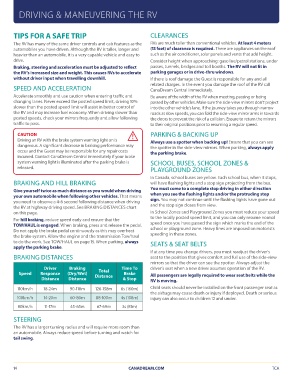
the RV at highway driving speed. See BRAKING DISTANCES chart when you see the flashing lights and/or the protruding stop
on this page. sign. You may not continue until the flashing lights have gone out
and the stop sign closes from view.
For hill braking, reduce speed early and ensure that the
TOW/HAUL is engaged. When braking, press and release the pedal. In School Zones and Playground Zones you must reduce your speed
Do not apply the brake pedal continuously as this may overheat to the locally posted speed limit, and you can only resume normal
the brake system. Allow the engine and the transmission Tow/haul speed once you have passed the sign which marks the end of the
to do the work. See TOW/HAUL on page 15. When parking, always school or playground zone. Heavy fines are imposed on motorists
apply the parking brake. speeding in these zones.
BRAKING DISTANCES SEATS & SEAT BELTS
Speed Driver Braking Total Time To If at any time you change drivers, you must readjust the driver's
Response (Dry/Wet) Distance Brake seat to the position that gives comfort and full use of the side-view
Distance Distance & Stop mirrors so that the driver can see the spotter. Always adjust the
driver’s seat when a new driver assumes operation of the RV.
110km/h 18-24m 90-110m 126-158m 6s (160m)
100km/h 14-20m 60-80m 88-100m 4s (108m) All passengers are legally required to wear seat belts while the
80km/h 11-17m 45-65m 67-69m 3s (81m) RV is moving.
Child seats should never be installed on the front passenger seat as
the airbags may cause death or injury if deployed. Death or serious
injury can also occur to children 12 and under.
STEERING
The RV has a larger turning radius and will require more room than
an automobile. Always reduce speed before turning and watch for
tail swing.
14 CANADREAM.COM TCA