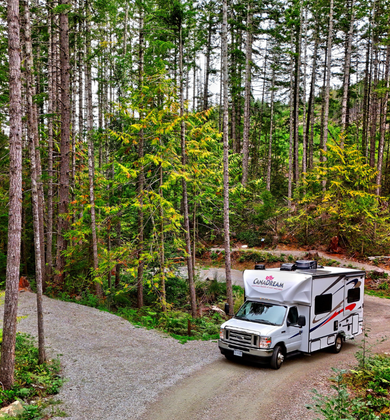
Camper van rentals cost less per day than motorhomes and use 30-40% less fuel, but motorhomes offer more living space, a full bathroom, and better value for larger groups, despite higher operating expenses. Choosing between a CanaDream camper van and motorhome depends on group size, trip duration, destination type, and your priorities for space versus economy.
May 2026
Camper Van Rental Costs vs Motorhome Costs: Which Fits Your Trip
May 3rd 2026
Is a Camper Van Actually Cheaper Overall?
Yes, a camper van is actually cheaper overall for couples and solo travellers on trips under two weeks, with lower daily rental rates, lower fuel consumption, and the flexibility to use standard parking spaces, avoiding premium campground fees. Camper vans like the Deluxe Van Camper or Super Van Camper deliver total trip savings of 25-35% compared to compact motorhomes.
Daily rental rates for camper vans run $150-200 lower than comparable motorhomes during peak season. A 10-day summer rental saves $1,500- $ 2,000 on the base rate alone. Fuel efficiency creates substantial ongoing savings, camper vans achieve 12-14 litres per 100 kilometres compared to 16-20 litres for compact motorhomes. On a 2,000-kilometre trip at $1.70 per litre, a camper van consumes $408-476 in fuel, compared with $544-680 for a compact motorhome.
Camper vans have access to campground sites that are unavailable to larger RVs. Many provincial parks and private campgrounds offer “small vehicle” sites at $25-35 per night that motorhomes cannot use. Urban destinations favour camper vans, with standard parking lots and street parking accommodating them, while motorhomes face costly parking hassles.
The cost advantage diminishes for groups of four or more. Camper vans accommodate two adults comfortably, but families requiring separate sleeping areas and full bathrooms find motorhome value improves despite higher costs.
Do Motorhomes Cost More Per Day or Just More to Operate?
Motorhomes cost more both per day in rental rates and to operate due to higher fuel consumption, but they provide significantly more living space, dedicated sleeping areas, full bathroom facilities, and better amenities that justify the premium for families and longer trips.
Daily rental rates for motorhomes are higher than for camper vans, depending on size and season. The Compact Motorhome represents the entry point, with rates above camper van rates, while the Maxi Motorhome commands premiums during peak season.
Operating costs compound the daily rate difference. Motorhomes consume 30-60% more fuel than camper vans, depending on size. Generator fuel consumption adds another layer, running generators for climate control consumes 2-4 litres per hour. Toll roads and ferry crossings charge a base fee based on vehicle size, with motorhomes paying $15-40 more per crossing.
The operational cost premium buys substantial benefits. Motorhomes include full bathrooms with showers, separate sleeping areas for privacy, full-size refrigerators, and slide-outs creating genuine living rooms. Weather protection matters more in motorhomes, rain, cold, or extreme heat affects camper van occupants more directly due to limited interior space.
Which Option Saves More on Fuel and Campsites?
Camper vans save more on fuel and campsites, reducing fuel costs by 30-40% through superior efficiency and accessing budget campground options unavailable to larger motorhomes, with total savings of $500-1,000 on a typical two-week trip covering 2,500 kilometres.
On a 2,500-kilometre journey at $1.70 per litre:
- Camper van: $510-595
- Compact motorhome: $680-765
- Large motorhome: $808-935
The camper van saves $170-340 compared to a compact motorhome on fuel alone. Multi-week trips covering 4,000-5,000 kilometres double these savings.
Campsite flexibility creates significant savings. When standard RV sites fill at $45-55 per night, camper vans use tent sites or small-vehicle sites at $30-40 per night. Over 14 nights, this $10- $ 20 daily difference saves $140- $ 280.
Downtown parking costs never factor into hotel budgets but impact RV travel, camper vans park in standard spaces at $3-8 per hour, while motorhomes pay premium RV parking at $15-25 daily.
When Does a Motorhome Make More Sense Despite Higher Costs?
A motorhome makes more sense despite higher costs when travelling with four or more people, taking trips exceeding two weeks, visiting remote areas requiring substantial water and waste capacity, travelling during extreme weather, or prioritizing comfort and space over economy.
Group size represents the primary factor favouring motorhomes. The per-person cost advantage shifts dramatically at four occupants. Extended trips benefit from motorhome amenities that seem less critical during week-long adventures. Living in an RV for 21-28 days requires proper showers, full kitchens, adequate storage, and defined spaces. A camper van is tolerable for 7-10 days, but becomes a frustrating constraint during month-long journeys.
Remote travel and boondocking favour motorhomes equipped with larger fresh water tanks and greater waste capacity. The Maxi Motorhome carries 300+ litres of fresh water, compared to 75-100 litres in camper vans. Extended stays at locations without services become feasible in motorhomes but force frequent service stops in camper vans.
Winter travel and extreme weather shift the calculation toward motorhomes. Four-season insulation and powerful heating systems enable comfortable cold-weather camping. Camper vans offer minimal insulation, making shoulder-season or winter travel challenging.
How Do Destination Types Affect Vehicle Choice?
Destination types affect vehicle choice by determining whether you need urban manoeuvrability, highway comfort for long distances, or capability for remote exploration, with each vehicle category excelling in different environments and travel styles.
Urban and City-Focused Trips
Camper vans dominate for trips centred on cities and tourist towns. Vancouver, Victoria, Quebec City, Montreal, and Halifax feature narrow streets, limited parking, and congested downtown cores, making motorhome navigation challenging. Camper vans park in standard spaces near attractions, navigate historic districts comfortably, and access underground parkades that are off-limits to taller vehicles. Day trips from urban bases to nearby attractions maintain this advantage.
Wine country tours through Niagara or the Okanagan favour camper vans significantly. Winery parking lots accommodate cars and vans but often restrict RVs. Restaurant parking, downtown tasting rooms, and scenic backroads through vineyards all work better with compact vehicles. The experience quality improves when you can park conveniently rather than searching for RV-accessible lots kilometres away.
Highway and Long-Distance Routes
Motorhomes provide superior comfort for trips covering substantial daily distances across highways. The Trans-Canada Highway from Ontario through the prairies to the Rockies, or maritime coastal routes connecting multiple provinces, benefit from motorhome amenities during long driving days. Cruise control, comfortable seating, onboard bathroom access, and the ability to prepare meals at rest stops make marathon driving days more comfortable.
Passengers in motorhomes can move freely during travel, access refrigerators for snacks, and use bathrooms without needing to stop for fuel. Families with young children particularly value this flexibility during 400-600 kilometre driving days common on cross-country routes. Camper van passengers remain confined to front seats throughout journeys.
Mountain and National Park Exploration
Mountain destinations present mixed advantages. Compact campervans navigate tight switchbacks and parking lots at trailheads more easily than large motorhomes. Popular spots like Lake Louise, Moraine Lake, and Maligne Canyon feature limited parking that fills early. Camper vans fit into standard spaces while motorhomes circle searching for RV spots or park kilometres away, requiring shuttle buses.
However, mountain camping favours motorhomes during cooler months. Nights at elevation in Banff, Jasper, or Yoho drop to 0-5°C even in summer. Motorhome heating systems maintain comfortable interiors, while camper vans require heavy sleeping bags and layers. Extended stays at mountain campgrounds justify motorhome comfort despite navigation challenges.
Remote and Off-Grid Adventures
Remote exploration definitely favours motorhomes. Crown land camping, forestry service roads, and extended stays at locations lacking services require substantial fresh water capacity, waste tank volume, and battery power. Motorhomes can go 3-5 days between service stops, while camper vans need water and dump access every 1-2 days.
Northern travel through Yukon, the Northwest Territories, or northern BC benefits from the self-sufficiency of a motorhome. Service station intervals stretch to 200+ kilometres in some regions. Having onboard bathroom facilities, cooking capacity, and sleeping comfort without reliance on external infrastructure provides security during remote adventures.
Which Vehicle Size Fits Different Group Types?
Different vehicle sizes fit different group types based on sleeping capacity, living space requirements, and budget priorities. Camper vans suit couples and solo travellers prioritizing economy and flexibility, compact motorhomes work for small families of three, midi and large motorhomes accommodate families of four to five, while maxi motorhomes serve groups of six or extended family.
The Super Van Camper represents the optimal choice for couples seeking maximum fuel economy and urban accessibility. The Compact Motorhome serves as the entry point for families with one or two young children. The Midi Motorhome suits families of four as the sweet spot between space and operating costs.
For detailed information about rental rates, included kilometres, and package options for each vehicle type, visit CanaDream Pricing FAQs.
Frequently Asked Questions About Camper Van vs Motorhome Costs
Does a motorhome use significantly more fuel than a camper van?
Yes, a motorhome uses significantly more fuel than a camper van. Motorhomes consume 16-22 litres per 100 kilometres, depending on size, compared to 12-14 litres for camper vans, representing 30-60% higher fuel costs. On a 2,500-kilometre trip at $1.70 per litre, this difference equals $170-340 in additional fuel expenses, with the gap widening proportionally on longer journeys or when operating generators for climate control.
Can a camper van comfortably accommodate a family of four?
No, a camper van cannot comfortably accommodate a family of four for trips lasting more than a few days. While some camper vans technically sleep four using convertible dinettes, the lack of separate sleeping areas, limited storage, and absence of full bathroom facilities create cramped conditions that frustrate families on extended trips. Families of four achieve better value and comfort in a Compact Motorhome or Midi Motorhome despite higher costs.
Do motorhomes make sense for trips shorter than one week?
No, motorhomes generally don't make sense for trips shorter than one week unless you’re travelling with four or more people or need specific motorhome amenities like full bathrooms. The higher daily rental rates and fuel costs cannot be offset by space and comfort advantages during brief trips. Couples taking 3-5-day getaways achieve better value in camper vans, while families of 4 or more find motorhomes worthwhile even on shorter trips due to per-person cost distribution.
Are campground fees higher for motorhomes than camper vans?
No, campground fees are not typically higher for motorhomes than camper vans at most provincial parks and national parks, which charge uniform rates regardless of RV size. However, camper vans can access small vehicle and tent sites for $5-15 less per night than motorhomes, and some private campgrounds charge length-based premiums of $5-15 per night for vehicles exceeding 25 feet. The cost advantage varies by destination and campground type rather than being universal.
Plan Your Perfect RV Adventure with CanaDream
CanaDream’s diverse fleet ensures you’ll find the right balance between cost and comfort for your travel style. Whether you choose our fuel-efficient camper vans for economical couples’ getaways or spacious motorhomes for family adventures, our experienced team helps match your vehicle to your budget and itinerary. Check our current special offers for seasonal promotions that maximize value across all vehicle categories, and join the CanaDream Club for exclusive member benefits. Contact our team today for personalized recommendations based on your group size, destination plans, and budget priorities; we’ll help you choose the vehicle that delivers the best adventure for your investment.